Before sunrise most mornings, crowds of young Ethiopians gather at Addis Ababa’s bus terminals, boarding routes toward Djibouti, Sudan, and points beyond. Many carry university degrees but little hope that the country can offer them stable work, safety, or a future. For a 24-year-old marketing graduate now stranded in Libya and preparing to attempt one of the region’s most dangerous migration crossings, the decision to leave didn’t feel like a choice at all: “I did not want to leave Ethiopia. Ethiopia left me.”
A young population with an uncertain future
Ethiopia’s population of more than 130 million skews remarkably young, with close to seven in ten people under age 29, a demographic base that could theoretically fuel decades of economic growth. But according to the source article this piece is based on, eight years of political instability, unresolved conflict, and governance breakdowns have eroded that potential. The piece argues that government spending priorities under Prime Minister Abiy Ahmed’s administration, including urban beautification projects, palace construction, and military expenditure, have come at the expense of addressing the conflict, insecurity, and ethnic tensions driving young Ethiopians away, and it further alleges harm specifically directed at the Amhara community and the Ethiopian Orthodox Church. These are contested characterizations advanced by the source and the Ethiopians it cites, rather than independently established facts.
The article also draws a historical comparison to forced population transfers and assimilation campaigns carried out in Nazi-occupied Europe, arguing that the international community’s relatively muted response to allegations of mass displacement, attacks on civilians, and repression in Ethiopia amounts to a double standard. That comparison reflects the author’s argument and framing rather than a neutral historical assessment.
Deadly routes, rising numbers
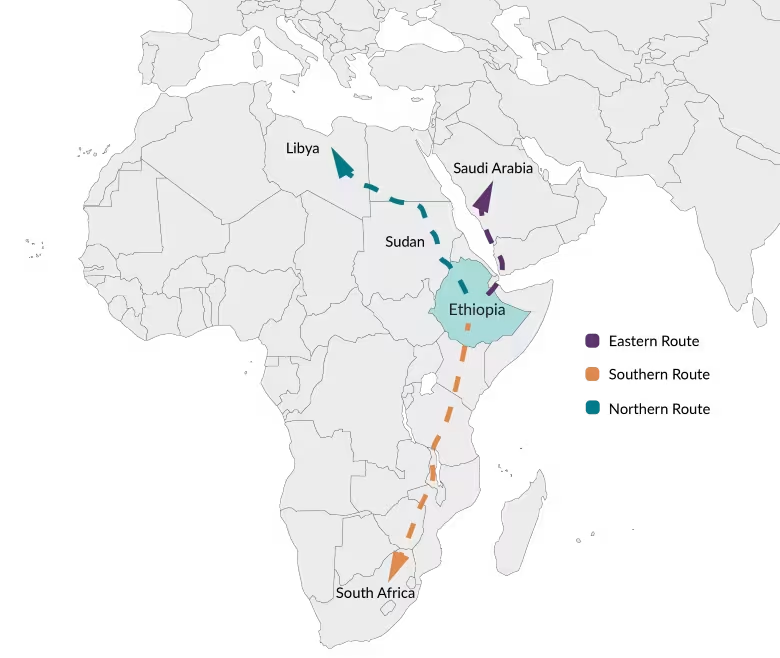
Whatever the underlying causes, the human toll of migration is well documented. The International Organization for Migration reported that nearly 8,000 migrants died or went missing worldwide in 2025 alone, pushing the cumulative total since 2014 above 82,000, losses estimated to have directly affected roughly 340,000 family members. The maritime corridor to Yemen has proven especially deadly for Ethiopian migrants attempting the eastern route through the Red Sea toward Saudi Arabia. Two other major corridors, a southern route toward South Africa and a northern route through Sudan, Libya, and across the Mediterranean toward Europe, expose travelers to trafficking, extortion, detention, and abuse at the hands of smuggling networks along the way.
Research cited in the piece, including a 2019 study by Gimenez and colleagues, points to conflict, ethnic tension, political instability, and insecurity as key drivers pushing African migrants toward Europe, even as rising numbers strain asylum systems and border management in destination countries.
A parallel exodus of skilled workers
Beyond the young people fleeing hardship, the source article highlights a quieter but consequential trend: doctors, engineers, academics, and journalists leaving for Canada, Australia, Europe, and the United States. The piece contends that unsafe working conditions, harassment, and the detention of colleagues have pushed skilled professionals to seek stability abroad, a brain drain it says undermines Ethiopia’s long-term institutional capacity and competitiveness.
Calls for international engagement
The article argues that national sovereignty should not shield governments from scrutiny when credible evidence of serious human rights violations exists, and it calls on bodies such as the United Nations, African Union, and European Union to press for accountability. Specific recommendations put forward include independent investigations into alleged abuses, renewed peace negotiations, expanded humanitarian support for displaced people, backing for independent media and civil society, cooperation against human trafficking, and targeted sanctions against officials implicated in serious violations.
These recommendations and the broader political claims underpinning them represent the perspective of the source article and the Ethiopians it quotes; readers should treat contested allegations against specific individuals or the government as claims requiring independent verification rather than settled fact.
Source: Adapted from “One Million Reasons to Leave: Ethiopia’s Youth Migration Crisis,” by Bekele Yonas, published in Borkena, July 6, 2026.