Asmara – As geopolitical tensions simmer across the Red Sea region, Eritrea finds itself at the center of a brewing crisis that threatens to plunge one of the world’s most isolated and repressive nations into renewed conflict with its larger neighbor, Ethiopia.
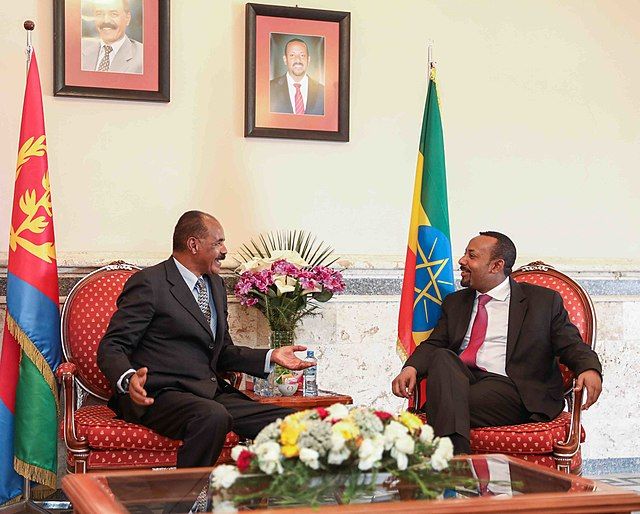
The current dispute centers on Ethiopian Prime Minister Abiy Ahmed’s increasingly vocal demands for access to Red Sea ports, particularly targeting the Eritrean port of Assab. Abiy has characterized regaining maritime access as correcting a “historical mistake” and addressing an “existential question” for his landlocked nation of over 120 million people.
Eritrea’s response has been sharp and unequivocal. Information Minister Yemane Gebremeskel has accused Ethiopia of territorial ambitions and attempting to provoke an “unjustified war,” raising the specter of renewed military confrontation between two countries that already share a brutal history of conflict.
Life Under Africa’s Most Repressive Regime
Inside Eritrea itself, public reaction to these escalating tensions remains muted, though this silence may be more indicative of the country’s authoritarian climate than genuine indifference. With media entirely under government control, many ordinary Eritreans may be unaware of the full extent of the diplomatic crisis unfolding around them.
The small nation of approximately 3.6 million people operates under what international observers consistently rank as Africa’s most repressive government. Political dissent is virtually non-existent, not due to popular satisfaction, but because citizens understand the severe consequences of speaking openly about governance or politics.
Despite the oppressive atmosphere, Eritrean society displays remarkable cohesion. The country’s diverse ethnic and religious communities coexist peacefully, from coastal regions along the Red Sea to highland markets where different groups intermingle without apparent tension. Visitors often note the hospitality and warmth of Eritreans, even as they navigate a society where political expression carries enormous personal risk.
From Liberation Hero to Authoritarian Ruler
The roots of Eritrea’s current political system trace directly to its tumultuous birth as an independent nation. President Isaias Afwerki, who has ruled since independence in 1993, was once celebrated internationally as a liberation hero who might usher in a new era of democratic governance in Africa.
In 1995, then-United States President Bill Clinton welcomed Isaias to the White House, praising what appeared to be initial steps toward democracy and economic liberalization. Western capitals had high hopes that Eritrea would become a model for the continent.
Those hopes proved tragically misplaced. Following a border clash with Ethiopia in 1998, Isaias reinstated compulsory military service and began systematically consolidating power. Opposition figures were arrested, independent journalists disappeared, and promised elections were indefinitely postponed. The war footing became permanent, and with it, authoritarian control deepened.
It was also during this period that Eritrea closed the port of Assab to Ethiopian trade, a move that continues to drive tensions today. Some Eritreans justify these measures as necessary for national security and unity given persistent threats from their much larger neighbor.
A History of Struggle and Betrayal
Understanding present-day Eritrea requires examining its complex colonial and post-colonial history. Italian colonization in the 19th century first established the boundaries of modern Eritrea and began forging a distinct national identity among its diverse populations.
After British forces expelled Italy during World War II, most Eritreans anticipated the establishment of an independent sovereign state. Instead, international diplomatic maneuvering led to a 1952 United Nations resolution forcing Eritrea into federation with Ethiopia, primarily to accommodate British regional interests and the preferences of Ethiopian Emperor Haile Selassie, who enjoyed widespread support in Western capitals.
The federation proved disastrous for Eritrean autonomy. While theoretically equal partners, Eritreans were rapidly marginalized. By 1962, Ethiopia had effectively dissolved the Eritrean assembly and annexed the territory outright. Eritrea had been decolonized from Italy only to be recolonized by Ethiopia.
The betrayal sparked a 30-year armed struggle for independence. Facing a vastly superior Ethiopian military, Eritrean fighters received minimal external support and were forced to develop extraordinary resourcefulness and resilience. Under Isaias’s leadership of the Eritrean People’s Liberation Front, they ultimately achieved victory in 1993.
The Legacy of Prolonged Conflict
Extended conflicts invariably shape national identities, as witnessed in places like Northern Ireland and Ukraine. Three decades of warfare against Ethiopia crystallized a powerful Eritrean national consciousness and an enduring determination to resist external domination.
This self-reliance remains visible throughout the country. In Asmara’s Medeber market, craftspeople demonstrate remarkable ingenuity, fashioning household items from scrap metal, used tires, and recycled materials. The market’s maze of dusty alleys showcases a culture of making do with limited resources.
However, as veteran Africa correspondent Michela Wrong has observed, the liberation movement’s unlikely triumph instilled an “indomitable self-belief” in the Eritrean People’s Liberation Front. The collective effort that defeated Ethiopian occupation never evolved into democratic institutions. The party, and Isaias specifically, became unable to accept any alternative political vision.
Eritrea’s repeated betrayals by the international community also fostered deep institutional distrust. After briefly emerging as an African liberation icon, Isaias turned decisively inward, transforming Eritrea into what critics describe as a hermit state largely cut off from global engagement.
The Human Cost of Authoritarian Governance
The impacts of decades of authoritarian rule are readily apparent to visitors. Military personnel maintain a visible, if not overtly threatening, presence throughout the country. Infrastructure decay and economic stagnation reflect the challenges of poor governance and international isolation.
Compulsory national service, which can extend indefinitely, has driven hundreds of thousands of Eritreans to flee the country, creating one of Africa’s largest refugee populations relative to national size. Young people face the prospect of years or even decades of poorly compensated military or government service with no clear endpoint.
International human rights organizations have documented severe restrictions on freedom of expression, assembly, and religion. Independent civil society organizations do not exist. The government tolerates no organized opposition, and political prisoners are held without trial in harsh conditions.
The Specter of Renewed War
Should conflict erupt again between Ethiopia and Eritrea, the outcome appears far less certain than during the independence struggle. Eritrea today is economically weakened, internationally isolated, and ill-prepared for confrontation with Ethiopia’s significantly larger military forces.
More importantly, it would be ordinary Eritreans who bear the catastrophic consequences. A population already suffering under repressive governance and economic hardship would face the additional horrors of warfare. The humanitarian impact could be devastating, potentially triggering mass displacement and a refugee crisis that would destabilize the broader Horn of Africa region.
The strategic importance of the Red Sea corridor adds an international dimension to the dispute. Major powers monitoring shipping lanes and military positioning could find themselves drawn into a regional conflagration with global implications.
An Uncertain Future
For now, tensions remain primarily rhetorical, but the stakes could hardly be higher. Ethiopia’s determination to secure sea access reflects genuine strategic and economic concerns for a rapidly growing landlocked nation. Eritrea’s adamant refusal stems from hard-won sovereignty and deep historical wounds.
Breaking this impasse will require diplomatic creativity and international engagement with a government that has shown little interest in either. The alternative—renewed warfare—threatens to compound the suffering of a people who have already endured colonization, forced annexation, a generation-long liberation struggle, and now decades of authoritarian rule.
As geopolitical temperatures rise around the Red Sea, the world’s attention may soon focus on a small nation that has long preferred isolation, potentially writing another tragic chapter in the Horn of Africa’s troubled history.
Source: This article is based on information gathered from The Conversation and news reports published on January 15, 2026.