Two of Africa’s deadliest ongoing conflicts may be on the verge of merging into a single, devastating regional war and Ethiopia appears to be the catalyst.
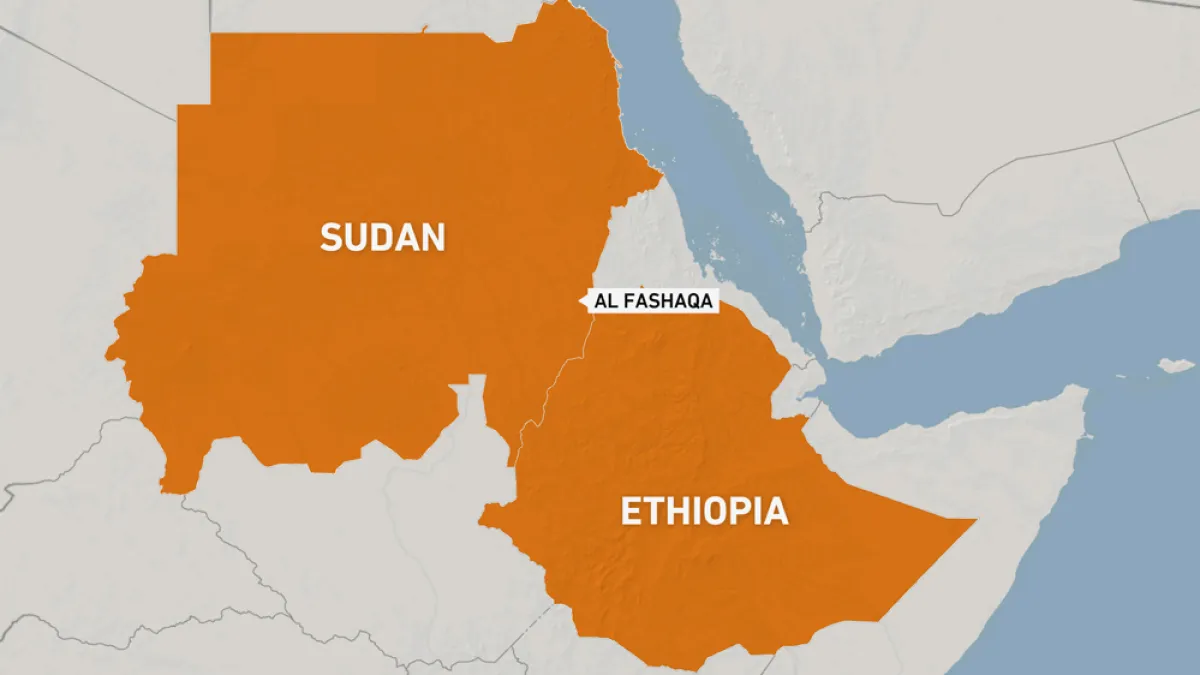
On March 23, a combined force of fighters from the Rapid Support Forces (RSF) and the Sudan People’s Liberation Movement-North (SPLM-N) overran the strategic town of Kerak in Sudan’s Blue Nile State. What set this offensive apart from previous engagements was where the attack originated: Ethiopian territory. According to Sudan’s Blue Nile governor, the fighters launched their assault from inside Ethiopia’s Benishangul-Gumuz region, where a large-scale training and logistics camp was reportedly established late last year with financial backing from the United Arab Emirates.
Reuters, in a recent investigative report, cited diplomatic cables and internal security memos suggesting the UAE financed the camp’s construction and provided military trainers and logistical support. Senior figures within Sudan’s military-led government have privately briefed journalists for months that Ethiopia has effectively become an active combatant in their country’s civil war.
A War Within a War
Sudan’s civil war, now entering its third year this April, has already produced staggering human suffering. The RSF’s seizure of the Darfur city of El Fasher last October unleashed a wave of mass killings estimated at roughly 60,000 deaths in just over a week, a toll that took 21 months to reach in Gaza. Despite this, the conflict has received comparatively little international attention.
The opening of a new front in Blue Nile State is widely seen as a strategic move by the RSF and its allies to stretch the Sudanese Armed Forces (SAF) thin, drawing troops away from the primary battleground in Kordofan, where the paramilitaries have faced a series of unexpected setbacks.
Why Is Ethiopia Getting Involved?
The motives driving Addis Ababa toward deeper involvement in Sudan are layered and deeply rooted in regional geopolitics.
First, Ethiopia is heavily financially dependent on the UAE, which has bankrolled Prime Minister Abiy Ahmed’s government since 2018. Emirati weapons, particularly drone shipments, were instrumental in helping Ethiopia win the brutal Tigray war between 2020 and 2022, a conflict estimated to have killed around 600,000 people. With the UAE backing the RSF in Sudan, analysts suggest Abu Dhabi has leveraged that dependency to pressure Addis Ababa into overt support for the paramilitaries. As Africa expert Cameron Hudson noted, Ethiopia appears to be acting less out of incentive and more out of pressure from the UAE.
Second, Ethiopia harbors deep grievances against the SAF dating back to the Tigray war, during which Sudan’s military seized disputed borderlands and later sheltered Tigrayan fighters. Those fighters have since helped Sudan’s army in combat operations, deepening Addis Ababa’s suspicion that the SAF is aligning with its enemies.
A Web of Dangerous Alliances
The regional dynamics extend far beyond Ethiopia and Sudan. Eritrea, fearing Ethiopian expansionism and a potential military push to seize sea access, is now arming Tigrayan rebels and deepening ties with the SAF. Eritrean airfields are sheltering Sudanese fighter jets, and Asmara is training anti-RSF groups aligned with the SAF in Darfur.
Egypt, meanwhile, has thrown its weight firmly behind the SAF, driven in large part by fears over Ethiopia’s Grand Ethiopian Renaissance Dam (GERD) on the Blue Nile, which Cairo sees as a threat to its water security. Egyptian forces have deployed Turkish-supplied drones to strike RSF supply convoys coming out of eastern Libya.
These overlapping alliances are gradually hardening into two rival blocs: one anchored by Saudi Arabia, Egypt, and Turkey, and another coalescing around the UAE and Israel, with the Horn of Africa increasingly becoming a proxy battleground between them.
South Sudan adds yet another dimension. Its government is descending into renewed civil conflict, with the SAF backing one faction while Juba’s leadership moves closer to the RSF. Uganda has already deployed troops to maintain stability in South Sudan’s capital, raising the prospect of further regional entanglement.
The Risk of a Regional Mega-War
Analysts from the International Crisis Group have warned that all the ingredients are now in place for a far wider conflict. The potential flashpoints are numerous: an Ethiopian military assault on Tigray, which saw heavy armor moved to the region’s borders in late February; a SAF retaliatory strike on Ethiopian territory to destroy the RSF training camp; or an Ethiopian move against Eritrea to secure sea access.
Any one of these scenarios could rapidly pull in neighboring states, transforming what are currently parallel conflicts into a single, continent-shaking war. Experts have drawn uncomfortable comparisons — not to 1939, but to 1914, when a tangled web of alliances dragged an entire continent into catastrophic conflict.
A Tragedy the World Is Ignoring
As Sudan’s war marks its third anniversary, the fighting shows no sign of ending. The RSF and SPLM-N are believed to have close to half a million fighters combined, while the SAF fields slightly more. Neither side appears capable of delivering a decisive blow, and the humanitarian toll continues to mount with little global response.
Whether or not the feared regional mega-war materializes, Sudan’s suffering is set to continue, a crisis fueled by foreign powers and largely ignored by the international community, even as it threatens to engulf the entire Horn of Africa.
Source: Warfronts, YouTube (youtube.com/watch?v=6zhbdN8jNy4). This article is an independent journalistic rewrite based on publicly reported information and does not reproduce original copyrighted content.