
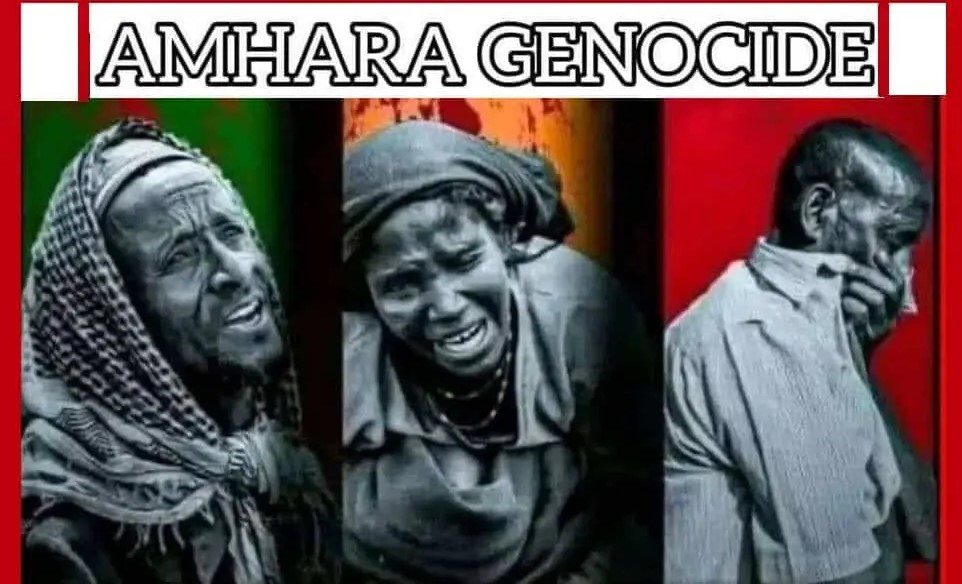
The Persecution, Displacement, Mass Killing, and Mass Arrest of the Amhara People in Ethiopia – Debebe SJ at Borkena Media.
A Comprehensive Analysis of Historical Narratives, Colonial Legacies, and Contemporary Human Rights Abuses
I. Introduction
Ethiopia, one of Africa’s oldest countries and the only sub-Saharan nation to successfully resist European colonization, harbours a profound internal contradiction. Beneath its proud history of unity and resistance lies a decades-long crisis of ethnic violence that has rendered one of its largest and most historically prominent communities , the Amhara, increasingly vulnerable, persecuted, and invisible on the world stage.
The Amhara people, numbering over 45 million and constituting approximately one-third of Ethiopia’s population, have long been central to the cultural, linguistic, and political identity of the Ethiopian state. Amharic is the country’s official working language; Amhara rulers built the imperial structures that united the nation; and Amhara soldiers helped defeat Italian invaders at the Battle of Adwa in 1896. Yet today, these same people are being killed, forcibly displaced, mass-arrested, and systematically marginalized, largely under the shadow of a political narrative that falsely casts them as colonial oppressors.
This article examines the origins and evolution of that narrative, its roots in Italian colonial ideology and Cold War-era Marxist student movements, its institutionalization under the Tigray People’s Liberation Front (TPLF)-dominated Ethiopian People’s Revolutionary Democratic Front (EPRDF) after 1991, and its deadly consequences in the present era. It also documents the ongoing human rights crisis: the mass arrests, aerial bombardments, forced displacement of hundreds of thousands, and the international silence that has accompanied these atrocities.
The story of the Amhara is not simply an Ethiopian story. It is a story about how constructed histories, invented grievances propagated for political gain, can transform a people from nation builders into targets. It is a story about how colonial frameworks, long after the colonizers have left, can shape and distort a society’s understanding of itself. And it is a story about the world’s failure to see, let alone stop, an unfolding humanitarian catastrophe.
II. Colonial Origins of the Anti-Amhara Narrative
The Italian Fascist Blueprint
To understand the persecution of the Amhara today, one must begin with Italy’s colonial ambitions in the Horn of Africa. After being decisively defeated by Emperor Menelik II’s army at the Battle of Adwa in 1896, one of the most significant defeats of a European colonial power by an African force, Italy returned to Ethiopia under Benito Mussolini in October 1935. The Italians occupied the country from 1936 to 1941.
Knowing that Ethiopian unity had defeated them at Adwa, the Italian Fascists devised a strategy of ethnic division.They systematically deconstructed Ethiopian nationhood by claiming that the state was merely a collection of subjugated ethnic groups under the domination of Amhara imperial rule. In direct contrast to the Ethiopians’ own sense of mystical national unity under the Emperor, the Italian colonial narrative split Ethiopian society into two categories: oppressor and oppressed. The Amhara were designated the oppressors; all other groups were the oppressed.
The Fascists specifically targeted the Amhara because the Ethiopian royal family was descended from the Amhara ethnic group. By framing the Amhara as ethnic colonizers rather than as builders of a multi-ethnic empire, Italy sought to undermine the political legitimacy of the Ethiopian state and fracture the social solidarity that had repelled them decades earlier. It was a calculated strategy of ‘divide and rule’, the same playbook European colonizers deployed across Africa.
The violence was immediate and severe. During the Italian occupation, between 600,000 and 800,000 Amharas were chased out from various parts of Ethiopia. The Italian colonizers introduced the discourse of ‘Amhara colonialism’ into Ethiopian political vocabulary, a concept that did not exist before, and that would prove devastatingly durable long after Italy’s expulsion.3
Marxist Student Movements and the Radicalization of Colonial Ideology
After Italian defeat and Ethiopia’s liberation in 1941, the colonial narrative should have died. Instead, it was absorbed, amplified, and radicalized by a new generation of Ethiopian students influenced by Marxist-Leninist thought in the 1950s and 1960s. Ethiopian student movements, inspired by Soviet-style anti-imperialist frameworks and applying them uncritically to their own country, adopted the Italian framing of Amhara domination as intellectual orthodoxy.
These students constructed the Amhara as the enemy of Ethiopia’s ‘Nations, Nationalities and Peoples’, a political category borrowed from Soviet nationality theory. Radicalised student groups established ethnonationalist organizations in the 1970s explicitly to ‘liberate’ designated oppressed ethnic groups from what they termed ‘Amhara colonialism.’ The concept of Amhara colonialism within a country that was never colonized was an ideological invention, yet it became the foundational framework for armed ethnonationalist movements.
Two movements in particular would reshape Ethiopia’s fate. The Tigray People’s Liberation Front (TPLF), founded in 1975, adopted an openly anti-Amhara manifesto in 1976. The manifesto explicitly stated in its original Tigrinya text: ‘The national struggle of the people of Tigray is anti Amhara national oppression.’ The TPLF accused the Amhara of being responsible for all of Ethiopia’s political, social, and economic problems.
Similarly, the Oromo Liberation Front (OLF), founded in 1973, declared that its overall objective was the liberation of the Oromo people from oppression and exploitation perpetrated by the Amhara. Both movements thus adopted the Italian colonial framing, repackaged it in Marxist language, and built armed insurgencies upon it. Academic scholarship has since described the TPLF’s rhetoric as ‘rooted in Italian colonial ideologies and shaped by the Ethiopian student movement.’ These movements would eventually seize state power in 1991 with catastrophic consequences for the Amhara.
III. Institutionalized Marginalization: Ethnic Federalism and the TPLF Era (1991–2018)
The Architecture of Ethnic Division
When the TPLF-dominated EPRDF took power in 1991 after defeating the Marxist Derg military regime, it implemented a system of ‘ethnic federalism’ that would give institutional form to its anti Amhara ideology. The federal constitution ratified in 1994 redefined Ethiopia’s political structure as a multi-ethnic federation based on ethno-national representation, creating nine ethnically defined regional states. Scholars have described this as a ‘Soviet-style federation that relied on ethnic self-determination for the creation of nine tribal homelands.’
The consequences for Amhara communities were immediate. Under the new ethnic geography, the Amhara, who had historically lived as an integrated and widely dispersed people throughout Ethiopia, found themselves reclassified. Where Amhara communities lived outside the designated ‘Amhara regional state,’ they were now defined as ‘settlers’ rather than citizens. The political vocabulary of Italian colonialism, transmitted through Marxist student ideology, was now embedded in constitutional law.
Anti-Amhara sentiment, which scholars trace to the Italian colonial period, found institutional expression in this ethnic federal architecture. Amhara people were portrayed as the opponent of Ethiopia’s Nations, Nationalities and Peoples, a framework that rendered Amhara synonymous with being an obstacle to justice and self-determination for other groups. This characterization was not merely rhetorical; it was enforced by the state.
Violence, Ethnic Cleansing, and Dispossession Under the EPRDF
The TPLF-era did not merely marginalize the Amhara politically; it presided over systematic genocide against Amhara communities. Human Rights Watch reports that approximately 320,000 Amharas were killed and evicted from Arba Gugu, a small province in the Oromia region, between 1991 and 2001 alone. These killings took place within a system that provided legal and institutional cover for ethnic violence.3
Displacement and targeted violence spread across Oromia, Benishangul-Gumuz, and southern regions. Amhara communities, reclassified as ‘settlers’ in their own country, were driven from lands they had farmed for generations, denied political representation, and subjected to ethnic cleansing with virtual impunity.
The government’s ethnic federalism project, far from alleviating inter-ethnic discord, intensified it. There is no argument that the tribal-based federation was itself the root cause of the country’s chaos, including the proliferation of divisive hate speech. By the 2000s, Amhara discontent was growing sharply. Many felt politically sidelined and economically neglected in a system that deepened ethnic divides rather than resolving them. The sense of exclusion and resentment became a defining feature of Amhara politics.
IV. The Abiy Ahmed Era: False Dawn and Intensified Persecution (2018–Present)
Hope and Betrayal
When Abiy Ahmed came to power in April 2018, hope swept across Ethiopia. A Nobel Peace Prize laureate, Abiy promised national reconciliation, released political prisoners, made peace with Eritrea, and dissolved the EPRDF in favor of a new Prosperity Party intended to transcend ethnic boundaries. For the Amhara, who had suffered systematic marginalization for nearly three decades, the new prime minister seemed to offer genuine change.
That optimism was rapidly extinguished. From 2018 onward, armed groups, particularly in the Oromo region, launched waves of ethnic violence against Amhara civilians. The government deliberately cries for intervention and rather colluded with the militias enabling the attacks. Mass killings and the forced displacement of Amhara communities spread across western and southern Ethiopia. Notable atrocities included the Gawa Qanqa massacre in 2020, where dozens of internally displaced Amhara persons were executed and buried in mass graves, and the Anno Town attacks in 2023. In Kiremu in 2022, 25 people were killed in extrajudicial executions. The Tole massacre in which more than 2700 Amharas were executed is the other shocking incident in which state and rebel collaboration was vividly seen.
The Tigray War, which erupted in November 2020, brought further catastrophe. Tigray revels, aka TDF, invaded the Amhara and Afar regions, committing documented atrocities including killings, looting, and widespread sexual violence in Wollo, Gondar, and Shewa zones. The war drew international attention to northern Ethiopia, but the suffering of Amhara civilians remained secondary in most international coverage.
The 2023 State of Emergency, State Terror and Mass Arrests
The most dramatic escalation came in 2023. In April 2023, the government ordered the disarmament of Amhara Special Forces, regional security forces that many Amhara saw as their primary protection against ongoing ethnic violence. The order was perceived as a deliberate act of vulnerability: the dissolution of the community’s only effective defense while the federal government simultaneously failed to protect civilians from attacks by armed groups from other regions.
The Amhara region erupted in armed resistance. In August 2023, the government responded by declaring a State of Emergency covering the entire country, the second such declaration in two years. The Emergency granted security forces sweeping powers of arrest without warrant and imposed extensive restrictions on movement and communication. What followed was a campaign of state terror characterized by extra judicial killings, mass arrests and open war on the people. Thousands of Amhara people, including politicians, academics, lawyers, journalists, civil servants, members of parliament, and ordinary citizens, are detained without charge.
The State of Emergency expired in June 2024. But the state terror and the arrests continued. In late September 2024, security forces launched a new wave of mass arbitrary detentions in the Amhara region. Hundreds of people were detained according to Amnesty International, including senior police and national intelligence members, as well as journalists, academics, lawyers, and civil servants. By January 2025, Amnesty International reported that thousands remained arbitrarily detained, marking four months since the September 2024 campaign began.
Military operations in the Amhara region during this period have been marked by tactics that human rights organizations characterize as collective punishment. Reports documented drone attacks on civilian populations in towns including Finote Selam, Quarit, and Dembecha, resulting in significant civilian casualties including women and children. Artillery shelling in Bahir Dar, Gondar, and Debre Markos accompanied federal troop operations. Critics described the campaign as targeting the Amhara people as a whole, while the government framed it as a counterinsurgency against extremists.
Displacement, Educational Collapse, and Humanitarian Crisis
The human toll has been staggering. The International Organization for Migration’s Displacement Tracking Matrix identified 3.3 million internally displaced persons across Ethiopia as of May 2024, with conflict as the primary driver (69%). The Amhara region accounted for a substantial share of this displacement, representing approximately 37% of returning IDPs nationally.
The impact on children has been devastating. As of November 2024, the Ethiopia Education Cluster reported that approximately 35% of children in the Amhara region, some 4.4 million children, were out of school. Some 5,109 schools had been damaged, 5,021 schools closed, and 1,069 schools repurposed for military or other uses. An entire generation risks losing its education to a conflict driven by political ideology rather than genuine security necessity.
Religious persecution has also intensified. Reports document the burning and destruction of more than 30 Ethiopian Orthodox churches between 2018 and 2019. In January 2023, a schism in the Ethiopian Orthodox Tewahedo Church caused significant casualties among worshippers. In November 2023, a series of attacks in the Arsi zone of the Oromia region resulted in the deaths of 36 Orthodox Christians. In February 2024, four clergymen were abducted and murdered, with the church attributing the killings to the Oromo Liberation Army.
V. International Silence, Impunity, and the Path Forward
A World Looking Away
The persecution of the Amhara has occurred largely without sustained international condemnation. The International Commission of Human Rights Experts on Ethiopia (ICHREE), the only international body monitoring Ethiopia’s human rights situation with a specific mandate, was terminated in October 2023, despite issuing multiple warnings about ongoing and future atrocity risks. With its termination, independent international monitoring of the crisis effectively collapsed.
Amnesty International has been among the most vocal international voices. In January 2025, the organization’s Regional Director for East and Southern Africa, Tigere Chagutah, stated that ‘the international silence over the mass and arbitrary detention of thousands of people in Amhara region is beyond shameful.’ He called on Ethiopia’s development partners, as well as African and global human rights bodies, to publicly demand the release of all arbitrarily detained persons. Despite these appeals, the international response has remained largely muted.
The United States State Department’s 2023 Country Report on Human Rights Practices in Ethiopia documented the government’s detention of thousands of ethnic Amhara and Oromo following the August State of Emergency, with reports of detainees held in inhumane and life threatening conditions and subjected to torture. The UK government’s own country policy note, updated in June 2025, acknowledged that arrests of those suspected of links to Amhara armed groups continued into 2025. Despite this documentation, concrete international action has not followed.
The Danger of Constructed Histories
The persecution of the Amhara offers an important lesson in how fabricated historical narratives can be weaponized over generations. The Italian Fascists invented the concept of ‘Amhara colonialism’ as a tactical instrument of division. Ethiopian student radicals absorbed and amplified it as revolutionary doctrine. The TPLF institutionalized it as constitutional principle. The result is a political culture in which violence against the Amhara can be framed as justice, and mass arrest can be described as counterinsurgency.
The academic literature is increasingly clear on this genealogy. A 2022 peer-reviewed study in Nations and Nationalism traced the construction of anti-Amhara sentiment directly to the Italian colonial period. A 2025 study in African Identities documented how ‘colonial narratives and systemic hatred against the Amhara’ have been reproduced through generations of political discourse. Research published in the Journal of Asian and African Studies identified this as ‘the tragedy of colonialism in a non-colonised society’, the importation of colonial divide-and-rule into an independent nation’s political bloodstream, where it proved equally corrosive.
The characterization of Amhara people as ‘settlers’ in their own country, a characterization embedded in the post-1991 constitutional order, echoes the logic of settler-colonialism discourse in a deeply distorted way. The Amhara did not arrive from another continent. They are indigenous to the Horn of Africa. Their historical association with the imperial state does not make them colonizers any more than the Zulu people’s association with the Kingdom of Zululand makes them European settlers. The application of this framework to Ethiopian internal politics is an analytical error with lethal consequences.
Conclusion: Recognition and Justice
The Amhara crisis demands recognition that has been scandalously withheld. Hundreds of thousands displaced, thousands arbitrarily imprisoned, millions of children out of school, aerial bombardments of civilian towns, and the systematic destruction of religious and cultural heritage, these are not the side effects of a counterinsurgency. They are the consequences of a political ideology built on false historical foundations, engineered by foreign colonizers, and perfected over decades by ethnonationalist movements that found in anti-Amhara hatred a unifying grievance.
The international community must restore independent human rights monitoring in Ethiopia, press for the immediate and unconditional release of arbitrarily detained Amhara civilians, and condition further diplomatic and financial engagement on measurable improvements in the human rights situation. Ethiopian civil society, academics, and political actors must be supported in developing a shared historical framework that acknowledges the complexity and richness of Ethiopia’s past, rather than the reductive, weaponized version that has served as justification for violence.
Ethiopia’s diversity is a genuine strength. But diversity cannot be a foundation for justice when one group is systematically designated as the enemy of all others on the basis of a history that was, in substantial part, invented by those who wished to conquer and divide the country. The Amhara people deserve what every community deserves: safety, dignity, political representation, and a future free from persecution. Whether the world will act before that future becomes impossible remains an open question — and an urgent one.
Footnotes and sources
1. UK Home Office, ‘Country Policy and Information Note: Amhara and Amhara Opposition Groups, Ethiopia,’ June 2025. Available at gov.uk. Covers State of Emergency, displacement figures, education impact, and ongoing arrests through 2025.
2. Sbacchi, A. (1985). Ethiopia Under Mussolini: Fascism and the Colonial Experience. Zed Books, London. Standard historical account of the Italian occupation of Ethiopia, 1936–1941.
3. Birhanu Bitew (2023), ‘The Tragedy of Colonialism in a Non-Colonised Society: Italy’s Historical Narratives and the Amhara Genocide in Ethiopia,’ Journal of Asian and African Studies. Published online January 2023. Also referenced in: Africa at LSE Blog, ‘Italian narratives about the Amhara helped lay the seeds of genocide in Ethiopia,’ February 27, 2023. Available at blogs.lse.ac.uk.
4. Procházka, R.F. (1936). Abyssinia: The Powder Barrel. British International News Agency. Historical account of Italian strategy in Ethiopia. Also: Braukämper, U. (2011), ‘Indigenous views on the Italian occupation in Southern Ethiopia,’ Aethiopica: International Journal of Ethiopian and Eritrean Studies 14: 164–183.
5. Yetena Birhanu (2022), ‘Discursive Trajectories in the Making of Amhara Identity in Ethiopia,’ Nations and Nationalism, Wiley Online Library. DOI: 10.1111/nana.12831. Traces anti-Amhara sentiment to the Italian colonial period (1936–1941).
6. Bekalu Wachiso Gichamo (2025), ‘The Perils of Colonial and Marxist Narratives in an Unconquered Land: Ethnic Based Killings and Evictions of the Amhara in Ethiopia,’ Journal of Asian and African Studies. DOI: 10.1177/00219096231200599.
7. Tigray People’s Liberation Front (TPLF) (1976), Manifesto of the Tigray Peoples’ Liberation Front. Mekelle, Ethiopia: TPLF. Cited in: ‘Colonial Narratives and Systemic Hatred Against the Amhara in Ethiopia,’ Tandfonline, 2025. DOI: 10.1080/14725843.2025.2544692.
8. Fantahun Ayele, ‘The Tigray People’s Liberation Front and Its Policy Towards the Amhara: History of Systematic Extermination, 1976–2018,’ African Identities. Published 2025. DOI: 10.1080/14725843.2025.2565309. Describes TPLF rhetoric as rooted in Italian colonial ideologies.
9. International Crisis Group (2009), ‘Ethiopia: Ethnic Federalism and Its Discontents,’ Africa Report No. 153. Available at crisisgroup.org. On TPLF-designed constitutional framework and ethnic regional states.
10. Fessha, Y. T. (2017), cited in ‘Colonial Narratives and Systemic Hatred Against the Amhara in Ethiopia,’ Tandfonline 2025. On the tribal-based federation as root cause of divisive hate speech. Also: Haile (2005), cited in same source, on Soviet-style ethnic federation.
11. DNE Africa / Daily News Egypt, ‘Inside Ethiopia’s Amhara Crisis: Power, Persecution, and War,’ October 2025. Covers EPRDF era violence, post-2018 atrocities, Fano resistance, and state of emergency.
12. Bantayehu Shiferaw Chanie and Ishiyama, J. (2021), ‘Political Transition and the Rise of Amhara Nationalism in Ethiopia,’ Journal of Asian and African Studies 56(5): 1036–1050.
13. Global Centre for the Responsibility to Protect, ‘Ethiopia Country Profile,’ updated March 2025. Documents extrajudicial killings, arbitrary detentions, forced displacement, sexual violence, and destruction of property by federal government forces and affiliated militias.
14. Human Rights Watch, ‘World Report 2025: Ethiopia,’ January 16, 2025. Available at hrw.org. Documents State of Emergency, mass arrests, targeting of journalists and politicians, and communications shutdowns in Amhara.
15. Amnesty International, ‘Ethiopia: Urgent International Action Needed to End Mass Arbitrary Detentions in the Amhara Region,’ January 29, 2025. Available at amnesty.org.
16. European Centre for Law and Justice (ECLJ), ‘The Silent Suffering of the Amhara People in Ethiopia,’ April 2024. Submitted to the UN Universal Periodic Review (47th Session). Documents drone strikes, extrajudicial killings, church attacks, and forced displacement. Available at eclj.org.
17. International Organization for Migration (IOM), Displacement Tracking Matrix (DTM), ‘National Displacement Report,’ May 2024. Available at dtm.iom.int. Also: IOM ‘Ethiopia Crisis Response Plan 2025,’ crisisresponse.iom.int.
18. Global Centre for the Responsibility to Protect, ‘Ethiopia,’ updated 2025. Notes ICHREE’s termination in October 2023 despite ongoing atrocity risk warnings.
19. U.S. Department of State, ‘2023 Country Reports on Human Rights Practices: Ethiopia,’ published January 2025. Available at state.gov. Documents mass arbitrary detentions, torture, enforced disappearances, and extrajudicial killings in Amhara and other regions.
By: Debebe SJ at Borkena Media.