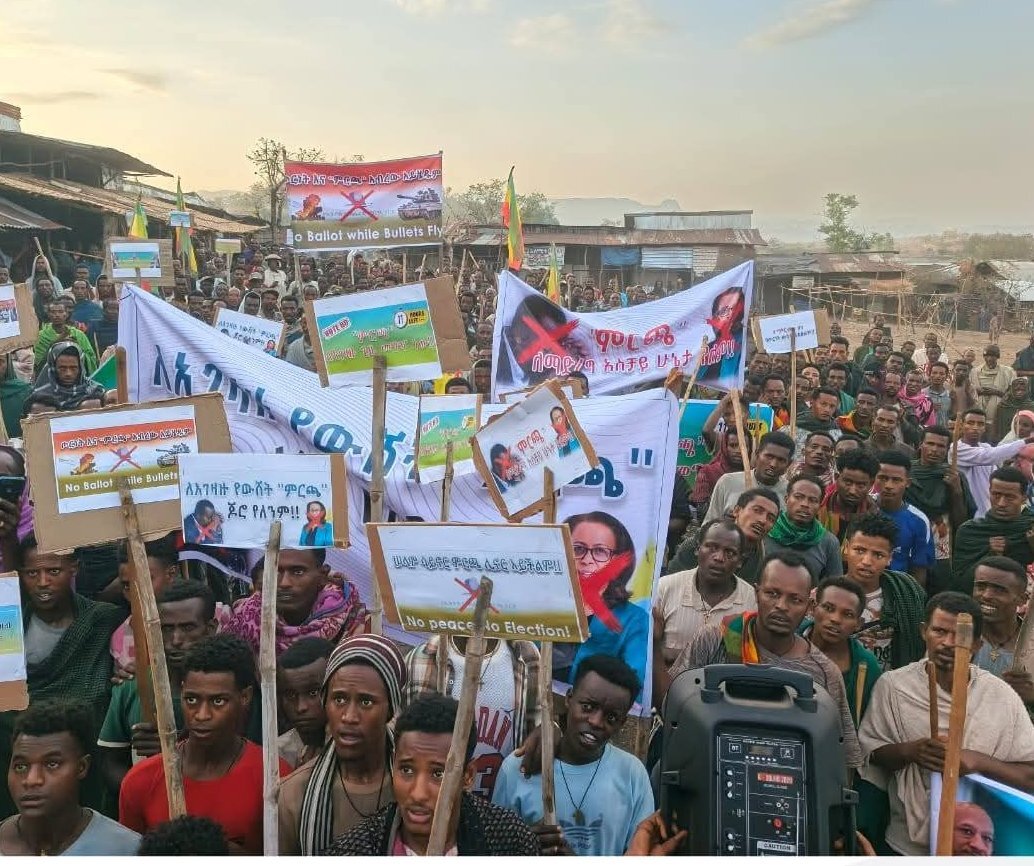
Widespread peaceful demonstrations broke out across multiple towns in Ethiopia’s Amhara region this week, with residents publicly calling for an end to the ongoing armed conflict and voicing strong opposition to national elections scheduled for June 2026. The protests mark a significant show of public dissent in a region that has been under severe military pressure for three consecutive years.
Demonstrators filled the streets of numerous towns, particularly those currently under the control of Fano rebel forces. Protest chants and placards carried a clear and unified message: that free and fair elections cannot take place while war continues to devastate the region. One widely displayed slogan translated to “There can be no election when there is no peace,” while others warned against what they described as allowing their oppressors to gain political legitimacy through the ballot box.
The timing of the demonstrations is notable, coming as the ruling Prosperity Party marks eight years since Prime Minister Abiy Ahmed came to power. Government-organized rallies in support of ruling party policies were simultaneously held in other parts of the country, including the Oromia, Benishangul-Gumuz, and Harar regions.
The Amhara region was once a stronghold of support for Prime Minister Abiy Ahmed, with many residents initially welcoming his administration with hopes of peace, democratic reform, and national unity. Those hopes have since given way to deep frustration. Over the past several years, ethnic Amharas have been killed or displaced in attacks in other parts of Ethiopia, most notably in the Oromia region, fueling the rise of the Fano armed movement, which frames its mission as a response to what it describes as an existential threat to the Amhara people.
The conflict in the Amhara region has now stretched into its third year, with government forces conducting drone strikes and artillery operations in areas where Fano fighters operate. Civilian casualties have been widespread. Human rights investigators and independent journalists have largely been barred from accessing the region, making it difficult to verify conditions on the ground. Despite repeated government assertions over the past two years that its military campaign is close to conclusion, active fighting has continued. While some rebel commanders have surrendered to government forces in recent months, analysts say this has not meaningfully reduced the scale of the armed conflict.
The overall human toll of Ethiopia’s various conflicts during the Abiy Ahmed era is staggering. The two-year war in the northern Tigray region alone is estimated to have resulted in well over 600,000 deaths, affecting the Afar and Amhara regions as well. Some observers now believe the destruction in the Amhara region has surpassed even that of the Tigray conflict.
The Ethiopian government, meanwhile, has projected an image of stability and national progress. Prime Minister Abiy Ahmed’s Prosperity Party claims a membership of over 16 million registered supporters. A Reuters investigation published in prior years revealed that the government deploys a large network of online operatives to shape public discourse and counter opposition voices on social media platforms.
As the June election date approaches, the scenes of mass protest in the Amhara region raise serious questions about whether the conditions exist for a credible democratic process in the country.
Source: Borkena Ethiopian News (borkena.com)