A new country report warns that Ethiopia faces converging crises, a looming armed conflict with Eritrea, unresolved atrocities in Tigray, and state violence against civilians in multiple regions, placing the country at multiple stages of the genocide warning scale.
Ethiopia–Eritrea tensions reach a boiling point
Relations between Ethiopia and Eritrea, once celebrated as a breakthrough when the two nations ended decades of hostility in 2018, have sharply deteriorated. The peace deal that earned Prime Minister Abiy Ahmed a Nobel Peace Prize has since unraveled, largely due to the devastating war fought in the Tigray region.
The current flashpoint centers on Ethiopia’s access to the Red Sea, specifically its ambitions toward Eritrea’s southern Assab port. Ethiopian leaders have issued military threats and conducted high-profile armed forces promotions, while state-linked media campaigns promote the narrative of reclaiming territory. Eritrea has responded by calling the matter legally resolved and accusing Addis Ababa of deliberately stoking hostilities.
Mass detentions and civilian killings in Amhara and Oromia
Inside Ethiopia’s borders, the situation is equally alarming. Regional security forces carried out sweeping mass arrests across the Amhara region in 2024, detaining thousands in what observers describe as arbitrary crackdowns targeting ethnic Amharans. Although several hundred were released in 2025, thousands remain imprisoned without clear legal basis.
Simultaneously, active armed conflict continues between federal and regional forces against the Fano militia in Amhara and the Oromo Liberation Army in Oromia. Civilian massacres were documented in both regions in 2023 and 2024, with reports indicating that a previously undisclosed secret government committee authorized some of the violence.
Tigray: genocide unacknowledged, survivors abandoned
Five years after the outbreak of Ethiopia’s civil war, there remains zero accountability for crimes committed against the Tigrayan population between 2020 and 2022. A detailed 2024 assessment by the New Lines Institute concluded that Ethiopian and Eritrean military forces jointly carried out acts of genocide in Tigray during that period.
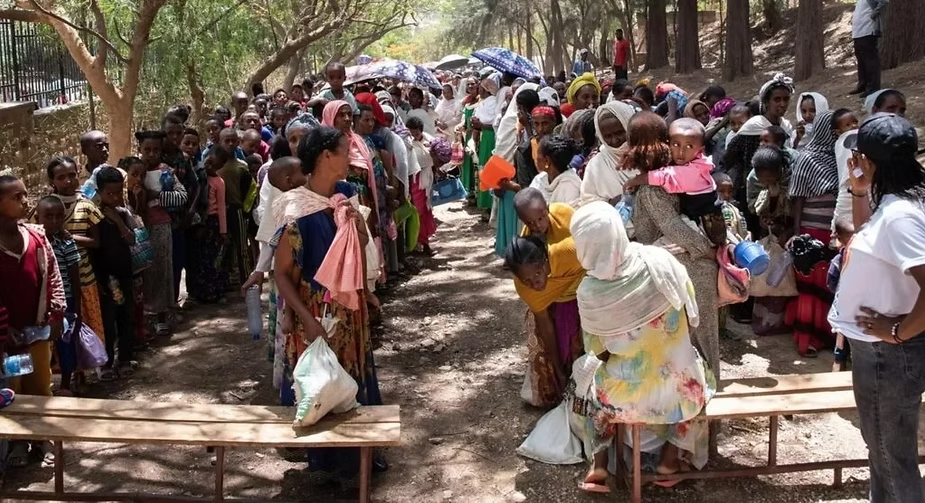
Today, Tigrayans continue to face systematic mistreatment including unlawful detention and freedom of movement restrictions. Approximately 800,000 people remain internally displaced within the region, relying on informal community support amid chronic food insecurity, medical shortages, and reduced humanitarian aid flows.
A fragile political order in Tigray was further destabilized in March 2025 when a rival faction within the Tigrayan People’s Liberation Front (TPLF) seized control of the regional mayor’s office and displaced local government officials. Ethiopia has since accused Eritrea of backing the dissident faction, a claim complicated by internal divisions within the TPLF itself. Adding to the contradictions, Ethiopia recently admitted that Eritrean forces killed civilians during the war, yet the government still refuses to acknowledge its own role in those atrocities.
Genocide Watch’s current assessment
Stage 3 – Discrimination, Stage 5 – Organization, Stage 10 – Denial
Key recommendations from Genocide Watch
Member states should bring formal charges against Ethiopia at the International Court of Justice for violations of the United Nations Genocide Convention relating to events in Tigray.
The United Nations Human Rights Council should establish an independent fact-finding mission to investigate reported massacres and other serious abuses perpetrated by Ethiopian and Eritrean armed forces, as well as regional militias.
The United Nations and the African Union should jointly facilitate formal mediation talks between the Ethiopian and Eritrean governments to reduce the risk of renewed interstate conflict.
Source: This article is based on the Ethiopia Country Report, April 2026, authored by Grace Harris and published by Genocide Watch. The original report is available at genocidewatch.com. All content in this article has been independently rewritten for editorial publication.