As Ethiopia moves toward its seventh general election, scheduled for June 1, 2026, an alarming pattern is taking shape, one that analysts, opposition leaders, and diaspora communities are calling a carefully managed political theater rather than a genuine democratic contest. At the center of the storm is Prime Minister Abiy Ahmed, whose government has been simultaneously dismissing the Ethiopian diaspora’s concerns with exclusionary rhetoric while tightening its grip on the political landscape ahead of the vote.
The “Leave Ethiopia to Us” Sentiment
A recent report by Addis Standard, one of Ethiopia’s most closely watched independent media outlets, documented a growing and deeply troubling rift between the Abiy Ahmed administration and millions of Ethiopians living abroad. The report highlighted the use of language that effectively tells the diaspora to stay out of Ethiopian affairs, a posture critics say is not only politically dangerous but fundamentally anti-democratic. The Ethiopian diaspora has historically been a major source of financial remittances, political advocacy, and civil society pressure. Their growing exclusion from national conversations signals a consolidation of power that alarmed observers say has been years in the making.
This dismissal of diaspora voices is not new. As far back as Abiy’s early tours of diaspora communities in the United States, analysts noted that the Prime Minister had little appetite for serious political debate. Prominent Oromo activist and political figure Jawar Mohammed, who met with Abiy privately during a rally in Minneapolis, later wrote that the Prime Minister refused to engage meaningfully with concerns about Ethiopia’s democratic roadmap, he simply wanted critics to move on.
The 2026 Election: A Coronation in Disguise?
Ethiopia’s upcoming vote has prompted serious concern from multiple international and regional outlets. Addis Standard itself, in a detailed analysis published in 2025, posed the uncomfortable question directly: is the 2026 election democracy’s last stand, or an authoritarian coronation? The conclusion drawn by most observers leans heavily toward the latter.
According to Africa Practice, a geopolitical risk consultancy, the 2026 election is shaping up to be a flawed replay of the 2021 vote, but with higher stakes and deeper instability. In 2021, the ruling Prosperity Party swept 410 out of 436 contested parliamentary seats. Major opposition parties in Oromia boycotted that election, and the Tigray region did not participate at all. Roughly one-fifth of parliamentary seats remained vacant due to the inability to hold votes in conflict-affected areas, a reality that analysts warn is set to repeat itself in 2026.
Foreign Policy has described the 2026 Ethiopian election as likely to be a “tick-box exercise” with a largely predetermined outcome. The magazine noted that major opposition parties, including the Oromo Federalist Congress and the Oromo Liberation Front, could once again boycott, leaving Abiy’s Prosperity Party with virtually no genuine competition. Meanwhile, the Africa Center for Strategic Studies confirmed that while 23 opposition parties have been accredited for the 2026 elections, many are viewed by political actors as extensions of the Prosperity Party’s own machinery rather than independent political forces.
The commentary platform Borkena / EthioPanorama has gone further, arguing explicitly that the election is a staged drama: opposition figures are either hand-picked by Abiy or sidelined through imprisonment and exile. Former senior Prosperity Party officials, including Dr. Lemma Megersa and Dr. Gedu, were reportedly forced to flee the country, while Taye Dendea was imprisoned for speaking out internally. The result, critics say, is that the ruling party acts as both the director and the cast of the electoral process.
Media Crackdowns and Transnational Repression
News24 and DW have documented an aggressive government campaign to suppress independent journalism ahead of the 2026 vote. Ethiopia currently ranks 145th out of 180 countries on the global press freedom index, with over 30 journalists imprisoned since 2018. The Abiy government has gone beyond its borders, reportedly approaching French authorities to seek the “extradition” of Ethiopian journalists in exile who have been critical of his administration. Similar pressure has been reported in South Africa, Kenya, and Uganda.
In April 2025, an amendment to Ethiopia’s media law expanded government control over the Ethiopian Media Authority, giving it broader powers to revoke licenses, a move that human rights organizations condemned as a further tool of suppression. Reuters had its correspondents’ accreditation revoked after it published an investigative report on an alleged secret military facility.
A Broken Political Landscape
Risk analysis firm Riskline has confirmed that Ethiopia’s elections will use a three-tier security classification system, with “red zones”, areas deemed too dangerous to vote in, effectively disenfranchising large portions of the population across Amhara, Oromia, and Tigray. This mirrors the 2021 experience, when entire regions were shut out of the democratic process.
Analysis published by Horn Report described the broader political situation as a “broken triangle”, a fundamental rupture between the central government and the country’s major ethnic and regional constituencies. The Amhara elite, once an ally of Abiy’s government during the Tigray war, now feels profoundly betrayed following a military crackdown on Amhara activists beginning in 2023. Meanwhile, armed insurgencies in both Amhara and Oromia continue to feed off high youth unemployment and public frustration.
Freedom House, in its 2025 Country Report on Ethiopia, confirmed that opposition party members continued to face restrictions on assembly, harassment, and arrest throughout 2024. Five prominent political figures were arrested in February 2024 alone under state-of-emergency provisions that denied them due process.
The Diaspora Fights Back
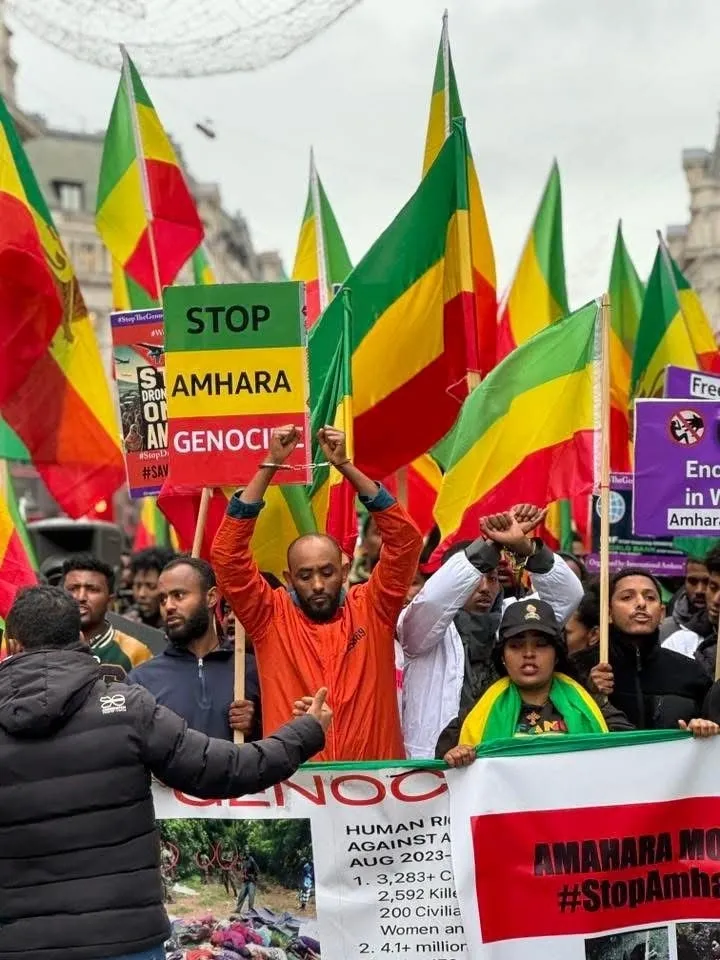
Despite Abiy’s administration urging Ethiopians abroad to stay out of domestic politics, diaspora communities across the United States, Europe, and beyond have become increasingly vocal. Organizations and individual commentators have amplified calls for independent international election observation, accountability for civilian atrocities, and genuine political dialogue, not the state-managed “National Dialogue” process that critics say excludes imprisoned and exiled stakeholders.
As Zehabesha / The Habesha has noted, the demand for Abiy Ahmed’s resignation has grown louder in diaspora circles through 2024 and 2025, with civil society groups calling for independent investigations into atrocities in Tigray, Amhara, and Oromia.
What Comes Next
With June 1, 2026 approaching, the international community faces a critical choice: legitimize an electoral process that analysts widely view as deeply flawed, or use diplomatic leverage to demand meaningful reforms. The Africa Center for Strategic Studies has called on the Ethiopian government to ensure independent functioning of electoral bodies, invite credible international observers, and adopt proportional representation to give minority voices a genuine seat at the table.
For now, the rhetoric of “leave Ethiopia to us”, directed at the very diaspora communities that have long sustained the country through remittances and advocacy, may prove to be one of the most politically costly miscalculations of the Abiy era. In silencing the voices of Ethiopians abroad while staging an election that few regard as free or fair, the Prime Minister risks deepening the very fractures his Medemer (“synergy”) philosophy was meant to heal.
Sources referenced in this article:
- Addis Standard (addisstandard.com) — original reporting on diaspora rift and rhetoric; 2026 election analysis
- Africa Practice (africapractice.com) — 2026 electoral dilemma analysis
- Foreign Policy (foreignpolicy.com) — 2026 Africa predictions
- Africa Center for Strategic Studies (africacenter.org) — Ethiopia 2026 election spotlight
- Riskline (riskline.com) — election security risk assessment
- Horn Report (hornreport.org) — convergence of crises analysis
- News24 / DW (news24.com) — media crackdown reporting
- Freedom House (freedomhouse.org) — 2025 Ethiopia Country Report
- Borkena / EthioPanorama (borkena.com / ethiopanorama.com) — opposition and election critique
- NPR (npr.org) — 2021 election coverage
- Zehabesha / The Habesha (zehabesha.com) — diaspora and opposition perspectives