Ethiopian American advocates have appealed to members of the U.S. Congress and the Trump administration to intervene on what they describe as an ongoing human rights and civilian-protection crisis in the Arsi Zone of Ethiopia’s Oromia Region, citing years of killings, abductions, mass displacement and repeated attacks on religious institutions.
A Rising Death Toll Documented Over Years
The appeal draws heavily on findings from the Ethiopian Human Rights Council (EHRCO), a domestic rights body, whose 158th Special Report, covering an investigation period stretching from 2021 into mid-2026, documented at least 450 to 458 civilian and local militia deaths across nine woredas (districts) of East Arsi, including Shirka, Merti, Jeju, Robe, Guna, Honkolo Wabe, Munisa, Aseko and Arsi Sire. Shirka and Merti districts accounted for the largest share of deaths, with well over 100 killings recorded in each. The report also documented physical injuries, abductions, enforced disappearances, sexual violence and the destruction of homes and churches, and said tens of thousands of residents had been displaced across the affected districts over the reporting period.
A separate rights body, the government-affiliated Ethiopian Human Rights Commission (EHRC), has issued its own repeated warnings about the same districts since late 2025, and in March 2026 formally accused fighters linked to the Oromo Liberation Army, designated by the government as OLF-Shene, of carrying out mass attacks on civilians in Shirka and Robe woredas. The Commission has said the security situation showed signs of improvement at times but that attacks continued to recur.
Attacks on Churches and Religious Communities
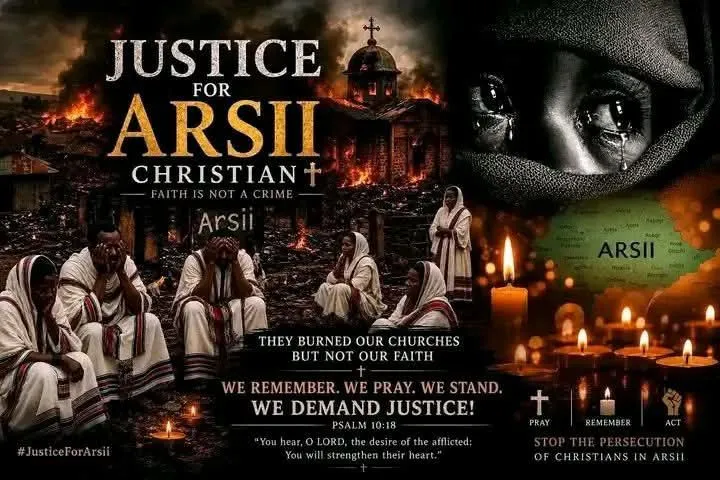
Among the most widely reported incidents was the burning of the historic Teleta Saint Gabriel Church in Aseko District, a site described by community leaders as roughly a century old. Reporting from early June 2026 described a fresh wave of violence beginning in late May around Teleta Gebriel, forcing residents to flee into surrounding forests as churches were destroyed and homes abandoned. Ethiopia’s three major religious bodies, the Ethiopian Orthodox Tewahedo Church, the Inter-Religious Council of Ethiopia and the Ethiopian Islamic Affairs Supreme Council, jointly condemned an attack that killed 21 civilians in Shirka Woreda, while cautioning against letting the violence be used to inflame inter-religious or inter-ethnic tension. The Orthodox Church’s Permanent Synod said survivors of that attack were abducted and remained unaccounted for, and that homes belonging to more than ten households had been burned.
Disputed Responsibility
Responsibility for the violence remains contested. Ethiopian federal and Oromia regional authorities have consistently attributed the bulk of the attacks to the Oromo Liberation Army, and Prime Minister Abiy Ahmed told parliament that one attack timed near the country’s general election was intended to disrupt the vote. The OLA, for its part, has denied targeting Orthodox Christian civilians and has instead pointed to unidentified “mercenaries” it says moved through the Arsi Zone to inflame religious and ethnic divisions. Neither federal nor Oromia regional officials had issued a formal response to EHRCO’s July 2026 report at the time of its release.
Advocacy groups, including Amnesty International, have separately documented abuses attributed to the OLA elsewhere in Oromia, including sexual violence, torture, killings and forced displacement, and have called on the group to order its fighters to comply with international humanitarian law and to demobilize members implicated in atrocities.
The Ethiopian American Appeal
In their message to Congress, Ethiopian American advocates argue the Arsi crisis should not be treated as an isolated local security matter, given that the violence has persisted for years and has repeatedly affected the same communities. They are asking U.S. lawmakers and the administration to:
- Support an independent, internationally credible investigation into the killings, abductions, displacement and attacks on religious sites in East Arsi
- Press Ethiopia to grant access to international human rights monitors, humanitarian agencies and journalists
- Back humanitarian assistance for displaced families, including shelter, food, medical care and psychosocial support
- Consider targeted accountability measures, such as visa restrictions or financial sanctions, against individuals credibly linked to serious rights violations
The advocates stressed that accountability should apply evenly to all armed actors and officials, regardless of ethnicity, religion or political affiliation, and that the goal is establishing facts and protecting civilians, not assigning collective blame to any community.
Sources: Borkena (borkena.com); The Reporter Ethiopia (thereporterethiopia.com); Addis Standard (addisstandard.com); Ethio Negari (ethionegari.com); Dawan Africa (dawan.africa); Ethiopian Human Rights Commission (ehrc.org).