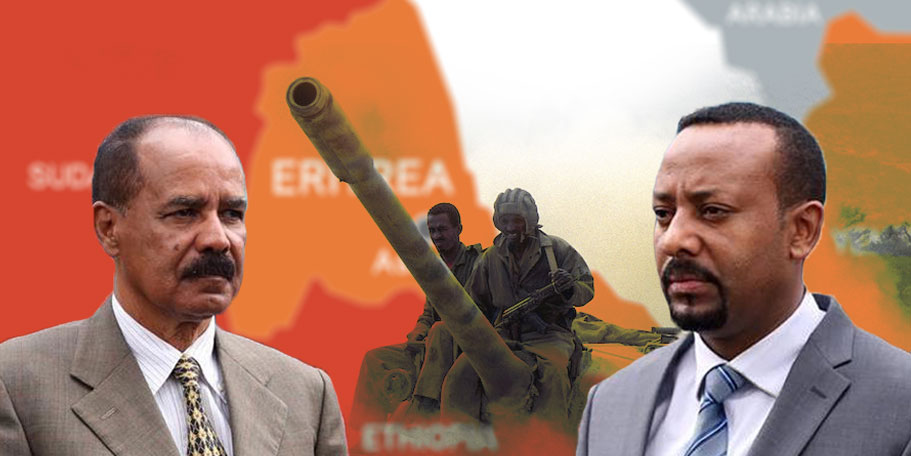
The Horn of Africa is facing its most dangerous moment in years. Alarming military movements, deteriorating diplomacy, and the haunting memories of a war that killed an estimated 600,000 people are converging to push Ethiopia and Eritrea toward what analysts increasingly describe as an inevitable confrontation, one that could once again make Tigray the epicenter of catastrophe.
A Region Mobilising for War
Over recent days, Ethiopia’s federal military has carried out what appears to be a sweeping national redeployment. Troops and heavy weaponry have been pulled from Wollega in Oromia, Metekel in Benishangul-Gumuz, Jigjiga, Harar, Dire Dawa, and multiple cities across the Amhara region, including Bahir Dar and Debre Berhan, and redirected northward toward Tigray. Images circulating widely on social media show artillery units and requisitioned trucks making their way toward the region. Ethiopia’s Ministry of Defence has simultaneously declared a state of maximum alert and called for thousands of discharged and retired military officers to return to service, with the Army General Staff opening registration for experienced combat troops.
Analysts writing for martinplaut.com draw a stark parallel to the months before Russia’s full-scale invasion of Ukraine in February 2022, noting that logistical signals, not rhetoric, are often the truest indicators of military intent. The Sahan intelligence cable cited in the analysis concludes that a state of maximum alert combined with artillery convoys heading north does not have the character of posturing, particularly when forces are being withdrawn from active security commitments elsewhere in the country.
The Eritrean Factor
At the heart of the current crisis is the deepening entanglement between Eritrea, the TPLF (Tigray People’s Liberation Front), and various other armed groups operating within Ethiopia. What analysts refer to as the “Tsimdo alliance” , a coordination framework linking Eritrea with the TPLF and Fano militias in Amhara, has become a central irritant for Addis Ababa. According to Horn Review, Eritrean forces, following the repulsion of a recent TPLF offensive, have expanded their footprint within Ethiopian territory, with some reports placing them as close as Tigray’s capital, Mekelle.
Ethiopia’s Foreign Minister Gedion Timothewos formally called on Eritrea to withdraw its troops, describing their incursion, in a widely cited open letter, as more than mere provocation. Asmara has categorically denied the presence of its forces on Ethiopian soil, with Eritrean Information Minister Yemane Gebremeskel dismissing the accusations as an agenda to justify war against Eritrea, as reported by Al Jazeera.
Prime Minister Abiy Ahmed, in an address to parliament early this month, also broke years of official silence by acknowledging that Eritrean forces committed atrocities during the 2020-2022 Tigray war — a shift in posture that carries significant political weight. Eritrea rejected the claims, calling them an attempt to rewrite a history in which the two governments had until recently been close allies.
Diplomacy Failing, Mediation Elusive
Multiple efforts to de-escalate the crisis through diplomatic channels have so far yielded little. The African Union publicly offered to mediate at the end of January, only to be told by the Ethiopian government to step back, according to martinplaut.com. Saudi Foreign Minister Prince Faisal bin Farhan visited Addis Ababa shortly afterward seeking reassurances that Ethiopia would not pursue military action, reassurances that were reportedly not given. Turkish President Recep Tayyip Erdoğan is expected in Addis Ababa this week, though analysts view his leverage as limited given the fundamentally different dynamics at play compared to the diplomatic environment that produced the Ankara Accord of 2024.
Horn Review warns that effective mediation is increasingly unlikely because most regional powers maintain significant stakes on one side or the other, stripping them of the neutrality required for credible brokerage. The African Union’s authority has waned, Washington has not initiated serious negotiations, and Eritrea has shown little appetite for dialogue.
Tigray Caught in the Middle
For ordinary people in Tigray, the escalating rhetoric and military movements are not abstract geopolitical concerns, they are existential ones. Al Jazeera spoke with residents in Mekelle who described a region running on fear. Saba Gedion, a 21-year-old displaced from Humera, recounted watching people leave the region by the thousands, many headed toward Afar in search of safety. Banks have seen successive runs, residents are stockpiling goods and fuel, and young people are seeking smugglers to help them leave Ethiopia entirely.
The region already carries the deep wounds of the last war. More than 80 percent of Tigray’s hospitals were left in ruins during the 2020-2022 conflict, according to humanitarian organisations cited by Al Jazeera. Hundreds of thousands of students remain out of school, the economy is crippled, and the federal government’s continued withholding of foreign funds from the region has deepened a humanitarian crisis that preceded any new outbreak of violence.
Kjetil Tronvoll, a professor of peace and conflict studies at Oslo New University College, told Al Jazeera that a new war would carry devastating consequences regardless of its outcome, potentially redrawing Ethiopia’s political map and pulling regional actors into a broader proxy conflict.
A Powder Keg in a Volatile Region
The broader regional picture adds further dimensions of risk. Ethiopia’s hosting of an Emirati-facilitated camp reportedly training over 4,000 Rapid Support Forces fighters for the Sudan war has drawn criticism and positioned Addis Ababa within a complex web of Gulf rivalries. Sudan’s ongoing civil war, itself sustained and complicated by competing foreign interventions, looms as a cautionary example of how quickly a localized crisis can spiral into a regionwide conflagration.
Horn Review warns that a conflict between Ethiopia and Eritrea could attract external backing from the Sudanese Armed Forces and potentially Egypt, transforming what might begin as a bilateral confrontation into a multi-actor regional war. The discovery of the RSF training facility makes clear, according to the martinplaut.com analysis, that any eruption of war in Ethiopia would refract across its neighbours with consequences that are difficult to predict.
As of the time of writing, no shots have been fired between Ethiopian and Eritrean forces in a formal sense. But the combination of large-scale military redeployments, failed diplomatic initiatives, a collapsing security architecture in northern Ethiopia, and a civilian population bracing for the worst has created conditions that analysts are struggling to distinguish from the prelude to war.
Sources: martinplaut.com (Sahan – Ethiopia Cable, Issue 319, February 17, 2026) | hornreview.org (Horn Review, Mahder Nesibu, February 18, 2026) | aljazeera.com (Samuel Getachew, February 18, 2026) | theafricareport.com (February 2026)