Ethiopia is heading into a general election on June 1 that analysts are already calling one of the least competitive in the country’s modern political history. Prime Minister Abiy Ahmed is widely expected to extend his grip on power, even as the country wrestles with active armed conflicts, economic strain, and a political opposition that is either in exile, underground, or effectively sidelined.
Abiy has led the country since 2018. His Prosperity Party swept the last general election in 2021, securing 485 out of 502 contested parliamentary seats, a margin that left virtually no room for meaningful opposition. That vote took place against the backdrop of the Tigray civil war, a conflict that claimed an estimated 600,000 lives and left deep scars across the country’s social and political fabric.
When Abiy first came to power, he was welcomed as a reformer. He eased restrictions on civil liberties, opened dialogue with long-standing political opponents, and brokered a peace deal with neighbouring Eritrea, earning him the Nobel Peace Prize in 2019. That goodwill, however, has largely eroded. Critics and human rights organisations say his administration has since reverted to authoritarian patterns, silencing dissenting voices, restricting press freedom, and clamping down on political rivals.
On the economic front, Abiy has pushed for a gradual opening of Ethiopia’s tightly controlled economy, hoping to draw in foreign investment and sustain what his government projects as double-digit growth. But Ethiopia’s dependence on oil imports has left it particularly exposed to the price shocks triggered by the broader conflict in the Middle East, squeezing households and businesses alike.
None of this appears likely to shift the electoral outcome. Notably, the ruling party has shown little urgency in campaigning, no major policy announcements, no visible slogans, and Abiy himself has not even formally confirmed he is seeking re-election. The confidence is tacit but unmistakable.
Abel Abate Demissie of the Chatham House think tank put it plainly, telling AFP that this election is set to be among the least competitive since multi-party democracy was introduced in Ethiopia in 1991.
Security concerns add another layer of uncertainty to polling day. Ethiopia’s most populous regions, Oromia and Amhara, are both experiencing ongoing insurgencies. Voting has already been cancelled in 30 of Amhara’s 137 constituencies, and the Fano, an armed Amhara militant group, issued a warning in March that anyone participating in the election would be treated as complicit and face consequences. Despite the deployment of roughly 500,000 federal soldiers and 30,000 police officers, the Africa Center for Strategic Studies has cautioned that conditions remain ripe for disruption.
Voting will also not take place in Tigray, where around one million people remain internally displaced following the civil war, and where the Tigray People’s Liberation Front, the region’s dominant political force, remains in a tense stand-off with the federal government.
While 23 parties are registered to contest the election, the majority are considered close allies of the ruling Prosperity Party. The credible opposition has largely refused to participate. As Abel noted, many of the more formidable opposition figures are either operating from exile or have taken up arms, leaving the ballot paper without any serious challenger to the incumbent.
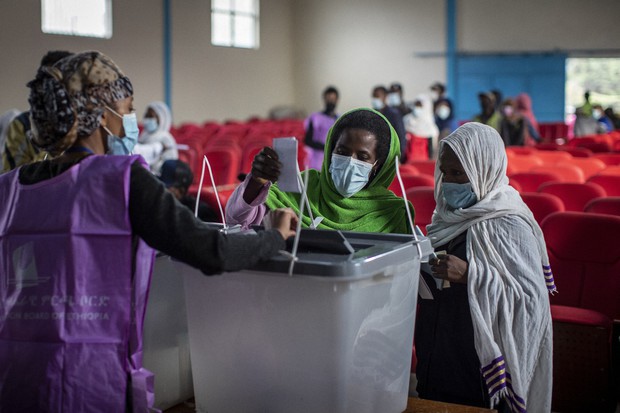
Organising the vote is itself a considerable undertaking. The government has allocated 10 billion birr, roughly $64 million, to run the election across approximately 49,000 polling stations spread across a country covering more than 1.1 million square kilometres.
When all is said and done, the result, in Abel’s words, is “pretty clear” and another landslide for Abiy Ahmed appears all but certain.
Source: AFP News Agency report on Ethiopia’s June 2026 general election.